PRN CRNA Jobs: How Part-Time Anesthesia Work Actually Works

Key Takeaways
- PRN work is not the same as locum tenens — it’s typically local, shorter-term, and doesn’t involve travel stipends
- Most facilities prefer PRN CRNAs with 2+ years of clinical experience, though some surgery centers welcome newer graduates
If you’ve ever searched for PRN CRNA jobs and wondered what the day-to-day actually looks like — how the scheduling works, what the pay really is, and whether it’s a viable long-term career strategy — you’re not alone. PRN (from the Latin pro re nata, meaning “as the situation demands”) is one of the most popular flexible work arrangements in anesthesia, yet it’s also one of the least understood.
Unlike a traditional full-time CRNA position, PRN work puts you in control of your calendar. You pick up shifts when they’re available and when you want them — no mandatory overtime, no fixed five-day workweek, no being locked into a single facility. For CRNAs who value autonomy, work-life balance, or supplemental income, PRN offers a genuinely different way to practice.
This guide breaks down exactly how PRN CRNA jobs work in 2026 — from compensation structure and tax implications to scheduling realities, facility expectations, and how PRN compares to locum tenens and travel assignments. Whether you’re a seasoned provider exploring a schedule change or a newer CRNA curious about flexible options, here’s everything you need to know.
📊 Salary Data Sources & Freshness This guide cites data from multiple sources: the U.S. Bureau of Labor Statistics (BLS, May 2024 — latest government data), ZipRecruiter (2026 advertised salaries), Glassdoor, AMN Healthcare, SalaryDr, and other industry reports. Government salary surveys have a 12–18 month reporting lag. Current advertised salaries on job boards typically reflect real-time market conditions and may be higher. Anesthesia provider compensation has risen steadily over the past five years.
What Does “PRN” Actually Mean for CRNAs?
PRN stands for pro re nata — a Latin phrase used throughout healthcare to mean “as needed.” In the context of CRNA employment, a PRN position means you work shifts on a flexible, as-needed basis rather than committing to a guaranteed number of hours each week.
How PRN Differs from Full-Time Employment
| Feature | Full-Time CRNA | PRN CRNA |
|---|---|---|
| Weekly hours | 36–40+ hours guaranteed | 0–40+ hours, your choice |
| Schedule | Fixed or rotating | Flexible, self-selected |
| Benefits | Health insurance, PTO, retirement, CME | Typically none (self-funded) |
| Pay structure | Salary or hourly (W-2) | Hourly (W-2 or 1099) |
| Call requirements | Usually required | Usually none |
| Facility commitment | Single employer | One or multiple facilities |
| Job security | High — guaranteed hours | Variable — depends on demand |
The core trade-off is straightforward: PRN CRNAs earn a higher hourly rate in exchange for giving up employer-provided benefits and guaranteed hours. You gain schedule flexibility but take on more responsibility for your own financial planning.
PRN vs. Per Diem — Is There a Difference?
In practice, “PRN” and “per diem” are used interchangeably in anesthesia staffing. Both describe the same arrangement: you work on an as-needed basis without a guaranteed schedule. Some facilities use “PRN” while others say “per diem,” but the employment structure is functionally identical.

PRN CRNA Jobs: Compensation Breakdown
One of the biggest draws of PRN work is the hourly rate premium. Because PRN CRNAs don’t receive benefits, facilities compensate with higher per-hour pay.
What PRN CRNAs Actually Earn
Based on current market data, PRN CRNA hourly rates vary significantly by region, facility type, and whether you’re working as a W-2 employee or a 1099 independent contractor:
| Compensation Metric | PRN CRNA Range |
|---|---|
| Average PRN hourly rate | $183/hr (Marit Health, 2026) |
| Typical hourly range | $150–$250/hr |
| High-demand / last-minute shifts | $200–$275+/hr |
| W-2 PRN rate | $140–$200/hr (lower, but simpler taxes) |
| 1099 PRN rate | $175–$250+/hr (higher, but self-employment tax) |
For context, the full-time CRNA market hourly rate is approximately $200/hr for permanent positions (2026). PRN rates at the higher end can match or exceed permanent rates because facilities need to incentivize providers who aren’t receiving benefits or guaranteed hours.
How PRN Compares to Full-Time CRNA Pay
| Metric | Full-Time CRNA | PRN CRNA (32 hrs/wk avg) |
|---|---|---|
| BLS median salary | $223,210/yr (BLS, May 2024) | N/A — varies by hours worked |
| Advertised average | $260,000/yr (ZipRecruiter, 2026) | N/A |
| Effective hourly rate | ~$200/hr (market rate, 2026) | $150–$250/hr |
| Annual gross (est.) | $220,000–$260,000+ | $150,000–$350,000+ |
| Benefits value | $30,000–$60,000/yr | $0 (self-funded) |
| Call pay | Often included | Usually none — no call |
The annual earnings for a PRN CRNA depend entirely on how many shifts you work. A PRN CRNA working 32 hours per week at $200/hr would gross approximately $332,800 annually before taxes — well above the BLS median of $223,210 (BLS, May 2024). However, after accounting for self-funded health insurance ($500–$1,500/month), retirement contributions, and self-employment taxes (for 1099 workers), the net take-home narrows.
W-2 vs. 1099: The Tax Reality
How you’re classified as a PRN CRNA matters enormously for your bottom line. For a detailed breakdown of all the tax implications, see our 1099 vs. W-2 CRNA guide.
| Factor | W-2 PRN | 1099 PRN |
|---|---|---|
| Tax withholding | Employer handles payroll taxes | You pay self-employment tax (~15.3% on first $176,100) |
| Deductions | Standard deduction only | Business expenses deductible (malpractice, CME, travel) |
| Malpractice insurance | Employer provides | You purchase ($3,000–$6,000/yr) |
| Retirement | May have 401(k) access | Solo 401(k) or SEP IRA (higher contribution limits) |
| Net hourly difference | Lower gross, simpler | Higher gross, more tax planning required |
Pro tip: Many experienced PRN CRNAs work 1099 through their own LLC or S-Corp, which allows them to optimize self-employment taxes while maintaining the flexibility of independent contractor status.
How PRN CRNA Scheduling Actually Works
The scheduling mechanics of PRN work vary by facility, but here’s what the typical arrangement looks like in practice.
Common Scheduling Models
Open shift board: The most common model. Facilities post available shifts (sometimes weeks in advance, sometimes 24–48 hours out), and PRN CRNAs claim the ones they want on a first-come, first-served basis.
Minimum commitment PRN: Some facilities require PRN CRNAs to commit to a minimum number of shifts per month — often 2–4 shifts — to maintain their PRN privileges and credentialing.
On-call PRN: A less common model where you’re available for last-minute needs. The facility calls when a case is added or a full-time provider calls out. These shifts often command premium rates.
Block scheduling: You and the facility agree on a recurring pattern (e.g., every Tuesday and Thursday) that’s flexible enough to adjust month-to-month.
What a Typical PRN CRNA Week Looks Like
PRN CRNAs report a wide range of weekly schedules depending on their personal goals:
- Supplemental income: 1–2 shifts/week (8–20 hours) alongside a primary position
- Near full-time flex: 3–4 shifts/week (24–40 hours) as a primary income source
- Semi-retired or lifestyle: 2–4 shifts/month on your own terms
- Seasonal: Heavy shifts during peak surgical months, lighter during slower periods
The beauty of PRN is that your schedule can change from week to week. Many CRNAs maintain PRN positions at multiple facilities simultaneously, giving them even more control over when and where they work.
Where PRN CRNA Jobs Are Most Available
PRN opportunities exist across virtually every practice setting, but some environments are especially well-suited to per diem staffing.
Top Settings for PRN CRNAs
Ambulatory surgery centers (ASCs): Surgery centers are among the best settings for PRN work. They run predictable Monday-through-Friday schedules, rarely require call, and handle a high volume of cases that create consistent per diem demand. ASC PRN rates often range from $175–$225/hr.
Hospitals: Large hospital systems maintain PRN pools to cover vacations, sick calls, and volume surges. Hospital PRN shifts may include evenings, weekends, or holidays — often at premium rates.
Outpatient procedure centers: GI suites, pain management clinics, and dental surgery centers frequently use PRN CRNAs for their procedure days. These tend to be daytime-only shifts with no call.
Physician offices: Plastic surgery practices, ophthalmology groups, and other office-based surgery settings hire PRN CRNAs for scheduled procedure days.
Geographic Demand Patterns
PRN CRNA demand is strongest in: - Metropolitan areas with multiple facilities competing for the same pool of per diem providers - States with CRNA-friendly practice authority — independent practice states often have robust PRN markets because CRNAs can practice without physician supervision requirements - Regions with anesthesia provider shortages, where facilities rely heavily on PRN and locum coverage to maintain operating room schedules
PRN vs. Locum Tenens vs. Travel CRNA: Key Differences
These three flexible work arrangements are often confused, but they serve different purposes and offer different benefits. For a deep dive into locum work, read our locum tenens CRNA guide, and for travel-specific information, see our travel CRNA jobs guide.
| Feature | PRN | Locum Tenens | Travel CRNA |
|---|---|---|---|
| Location | Local — your own market | Regional or national | National — you relocate |
| Duration | Ongoing, shift-by-shift | Contracts (weeks to months) | Contracts (8–26 weeks) |
| Housing/travel | You commute from home | Often provided or stipended | Housing stipend included |
| Hourly rate | $150–$250/hr | $200–$325+/hr | $200–$325+/hr |
| Annual potential | $150K–$350K+ (varies) | $400,000–$550,000+ | $400,000–$550,000+ |
| Credentialing | Facility-specific | Agency handles | Agency handles |
| Benefits | Rarely | Rarely | Some agencies offer limited |
| Best for | Local flexibility | Higher pay + some travel | Maximum pay + adventure |
The key distinction: PRN is a local arrangement — you live in your community and pick up shifts at nearby facilities. Locum tenens and travel CRNA positions involve working at facilities that may be hours or states away, typically through a staffing agency, with higher pay to compensate for the travel and temporary relocation.
Many CRNAs combine strategies — maintaining a PRN position locally for steady income while taking occasional locum tenens assignments for higher-paying blocks.
Who Should Consider PRN CRNA Jobs?
PRN work isn’t for everyone, but it’s an outstanding fit for certain career stages and lifestyle priorities.
PRN Is Ideal For:
Experienced CRNAs seeking schedule control: If you’ve spent years in full-time practice and want to reclaim your calendar, PRN lets you work exactly as much (or as little) as you choose. Many providers in their 40s and 50s transition to PRN for improved work-life balance.
CRNAs supplementing a primary position: Working a 0.8 FTE at one facility and picking up PRN shifts at another is a common strategy to boost income while maintaining benefits through a primary employer.
Parents and caregivers: PRN scheduling accommodates school pickup times, elder care responsibilities, and other commitments that don’t fit a rigid 7-to-3 schedule.
CRNAs exploring new settings: PRN is a low-commitment way to try different practice environments — surgery centers, hospitals, GI suites — without signing a long-term contract.
Semi-retired providers: PRN allows experienced CRNAs to scale down gradually rather than stopping practice abruptly, keeping skills sharp while enjoying more time away from the OR.
When PRN Might Not Be the Best Fit
New graduates with limited experience: Most PRN positions require 1–3 years of independent practice experience. Facilities hiring PRN providers expect you to walk in, review the chart, and manage cases autonomously from day one. If you’re a new grad, consider starting with a full-time position that offers mentorship — our new grad CRNA guide covers this transition in detail.
CRNAs who need predictable income: If you have significant student debt, a new mortgage, or other fixed financial obligations, the variable income of PRN work can create stress. Starting with a full-time salaried position at $220,000–$260,000 provides a stable foundation.
Providers who want comprehensive benefits: Self-funding health insurance, disability insurance, malpractice coverage, retirement, and CME costs adds up. If the idea of managing all of that yourself feels overwhelming, a full-time W-2 position may be a better choice.

How to Find and Land PRN CRNA Jobs
Where to Search
The best PRN opportunities come through a combination of channels:
- AnesthesiaJobs.com: Browse dedicated CRNA job listings filtered for PRN and part-time positions
- Direct facility outreach: Contact surgery centers, hospitals, and anesthesia groups in your area directly — many PRN positions are filled through word-of-mouth before they’re ever posted
- Professional networks: AANA state chapters, local CRNA groups, and social media communities regularly share PRN opportunities
- Staffing agencies: Some agencies specialize in local per diem placement alongside their locum tenens offerings
What Facilities Look For in PRN CRNAs
When hiring PRN providers, facilities typically prioritize:
- Clinical versatility: Comfort with a broad case mix — general, orthopedic, GI, OB (if applicable), and regional anesthesia
- Independence: Ability to manage cases with minimal orientation or hand-holding
- Reliability: Showing up when you commit to a shift (canceling at the last minute will quickly get you removed from a PRN pool)
- Active credentials: Current state license, national certification, BLS/ACLS/PALS, and malpractice insurance (if 1099)
- Experience: Most facilities prefer 2+ years, though ambulatory surgery centers with straightforward case mixes may be more flexible
Negotiating Your PRN Rate
PRN rates are more negotiable than many CRNAs realize. Consider these strategies:
- Know your market: Research what other facilities in your area pay for PRN shifts — the $150–$250/hr range is broad, and your specific market may skew higher or lower
- Leverage urgency: Last-minute and hard-to-fill shifts (evenings, weekends, holidays) command premium rates
- Offer consistency: If you can commit to a minimum number of shifts per month, some facilities will offer a higher guaranteed rate
- Bundle facilities: Working PRN at multiple locations gives you leverage — you can shift your availability toward whichever facility pays the best rate
- Negotiate annually: As the CRNA market continues to tighten (38% projected job growth through 2032), your rate should increase over time
Making PRN Work Financially: A Practical Framework
Transitioning to PRN — whether fully or partially — requires financial planning that goes beyond comparing hourly rates.
The True Cost of Going PRN
| Expense | Monthly Estimate | Annual Estimate |
|---|---|---|
| Health insurance (individual) | $500–$1,500 | $6,000–$18,000 |
| Disability insurance | $200–$400 | $2,400–$4,800 |
| Malpractice insurance (if 1099) | $250–$500 | $3,000–$6,000 |
| Retirement contributions (self-funded) | $1,500–$5,000+ | $18,000–$69,000 |
| CME costs | $200–$500 | $2,400–$6,000 |
| Self-employment tax (1099 only) | Varies | ~$20,000–$27,000 |
| Total self-funded costs | $2,650–$7,900 | $31,800–$130,800 |
When a full-time employer provides these benefits, their value is typically $30,000–$60,000 annually. That means a PRN CRNA earning $200/hr needs to work enough shifts to cover both their desired income and these additional costs.
Breakeven Analysis: PRN vs. Full-Time
A CRNA earning $260,000 in a full-time salaried position with $50,000 in benefits receives roughly $310,000 in total compensation. To match that as a 1099 PRN provider:
- At $200/hr: ~1,550 hours/year (about 30 hours/week)
- At $225/hr: ~1,378 hours/year (about 27 hours/week)
- At $250/hr: ~1,240 hours/year (about 24 hours/week)
At $225/hr or above, many PRN CRNAs can match full-time total compensation while working fewer hours — and that’s the real value proposition. For a broader look at how anesthesia providers optimize their schedules, explore our guide to the best anesthesia jobs for work-life balance.
Related Reading
- Locum Tenens CRNA Guide: Everything You Need to Know
- Travel CRNA Jobs: Your Complete Guide
- Surgery Center CRNA Jobs: What to Expect
- Anesthesia Work-Life Balance: A Provider’s Guide
- 1099 vs. W-2 CRNA: Which Is Right for You?
- New Grad CRNA Guide: Launching Your Career
Ready to find your next flexible anesthesia opportunity?
Browse CRNA Jobs on AnesthesiaJobs.com →
Frequently Asked Questions
What does PRN mean for CRNA jobs?
PRN stands for pro re nata, a Latin term meaning “as needed.” In CRNA employment, a PRN position means you work on a flexible, per diem basis — picking up shifts as they become available rather than committing to a fixed full-time schedule. PRN and per diem are used interchangeably in anesthesia staffing.
How much do PRN CRNAs make per hour?
PRN CRNAs typically earn $150–$250 per hour depending on geographic region, facility type, and whether they work as W-2 employees or 1099 independent contractors (Marit Health, 2026). The average PRN CRNA hourly rate is approximately $183/hr (Marit Health, 2026), though high-demand or last-minute shifts can pay $200–$275+/hr. For comparison, the full-time CRNA market rate is approximately $200/hr (2026), and the BLS median annual salary is $223,210 (BLS, May 2024).
Can new graduate CRNAs work PRN?
While it’s not impossible, most facilities prefer PRN CRNAs with at least 1–3 years of independent clinical experience. PRN positions typically require providers to function independently with minimal orientation. New graduates are generally better served starting with a full-time position that provides structured mentorship and a stable starting salary of $220,000–$260,000. Some ambulatory surgery centers with straightforward case mixes may be more open to newer providers in PRN roles.
What is the difference between PRN and locum tenens CRNA work?
PRN work is local — you pick up shifts at facilities in your own community and commute from home. Locum tenens involves temporary assignments at facilities that may be in different cities or states, typically arranged through a staffing agency, with travel and housing often provided. Locum CRNAs earn $200–$325+/hr ($400,000–$550,000+ annually), generally higher than local PRN rates, to compensate for the travel and temporary relocation.
Do PRN CRNAs get benefits?
Most PRN positions do not include employer-provided benefits such as health insurance, paid time off, retirement matching, or malpractice insurance. PRN CRNAs are responsible for self-funding these costs, which can total $30,000–$60,000+ per year. Some W-2 PRN positions at large health systems may offer limited benefits like retirement plan access, but this is the exception. The higher hourly rate of PRN work is designed to offset the lack of benefits.
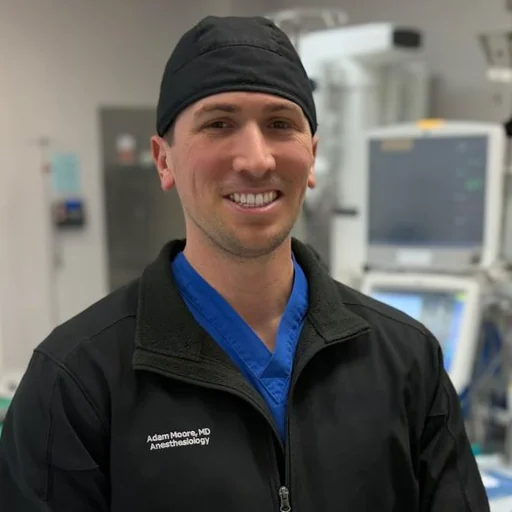
Practicing anesthesiologist with experience across MD-only, medical supervision of CRNAs, and medical direction of CAAs. Founded AnesthesiaJobs.com to help anesthesia professionals find the best job for their personal and professional life.
More about Adam →