CRNA Student Loan Forgiveness: Complete 2026 Guide

Key Takeaways
- CRNAs qualify for multiple loan forgiveness programs, including PSLF (full forgiveness after 10 years), NURSE Corps (up to 85% of nursing debt), and NHSC (up to $50,000+)
- Most CRNA graduates carry $100,000–$200,000 in student loan debt — but with median earnings of $223,210 (BLS, May 2024), repayment is highly manageable
- Public Service Loan Forgiveness (PSLF) is the single most powerful tool for CRNAs — and the majority of hospital employers qualify
- New 2026 legislative changes affect federal loan caps and income-driven repayment plans — this guide covers what you need to know
- Strategic loan management can save CRNAs $50,000–$150,000+ over the life of their loans
CRNA student loan forgiveness is one of the most valuable — and most overlooked — financial tools available to nurse anesthetists. With CRNA program tuition ranging from $48,000 to over $175,000 and most graduates carrying six-figure debt, understanding every forgiveness and repayment option isn’t optional — it’s essential financial planning. The good news: CRNAs are among the best-positioned healthcare professionals to manage and eliminate student debt, thanks to high earnings and broad eligibility for federal and state programs.
Whether you’re a student registered nurse anesthetist (SRNA) mapping out your financial future, a new grad CRNA weighing repayment strategies, or a practicing CRNA exploring forgiveness options you may have missed, this guide covers every program, strategy, and 2026 legislative update that matters. For a complete look at CRNA career opportunities and compensation, visit our CRNA jobs hub.
📊 Salary Data Sources & Freshness This guide cites data from multiple sources: the U.S. Bureau of Labor Statistics (BLS, May 2024 — latest government data), ZipRecruiter (2026 advertised salaries), Glassdoor, AMN Healthcare, SalaryDr, and other industry reports. Government salary surveys have a 12–18 month reporting lag. Current advertised salaries on job boards typically reflect real-time market conditions and may be higher. Anesthesia provider compensation has risen steadily over the past five years.
How Much Student Loan Debt Do CRNAs Carry?
Before diving into forgiveness programs, it’s important to understand the scope of CRNA student loan debt and why it’s so manageable relative to other graduate health professions.
The Cost of CRNA Education
CRNA programs (DNP or DNAP) typically span 3–4 years of intensive, full-time graduate study. The financial picture includes:
| Cost Component | Typical Range |
|---|---|
| Program tuition (total) | $48,000–$178,000 |
| Average program tuition | ~$110,000 |
| Books, fees, and supplies | $3,000–$10,000 |
| Living expenses (3 years) | $36,000–$90,000 |
| Lost RN wages (opportunity cost) | $195,000–$280,000 |
| Total graduate loan debt (typical) | $100,000–$200,000 |
Most CRNA graduates carry $100,000–$200,000 in student loan debt at graduation. Public in-state programs at schools like Idaho State University ($48,000) or the University of Alabama–Huntsville ($55,000) sit at the lower end, while private institutions like Columbia ($175,000) or Duke ($148,000) push toward the upper range.
Why CRNA Debt Is Highly Manageable
Here’s the critical context: CRNAs earn a median salary of $223,210 (BLS, May 2024), with advertised positions averaging $260,000 (ZipRecruiter, 2026) and starting salaries of $220,000–$260,000. That means even a CRNA with $200,000 in debt has a debt-to-income ratio under 1:1 — far more favorable than many healthcare professions.
At a starting salary of $220,000, a CRNA dedicating 20% of gross income to loan repayment ($44,000/year) could eliminate $200,000 in debt within approximately 5 years, even accounting for interest. Add a forgiveness program to the mix, and the timeline shrinks dramatically.

CRNA Student Loan Forgiveness: Federal Programs
Federal forgiveness programs offer the largest benefits for CRNAs. Here’s a complete breakdown of every major program available in 2026.
Public Service Loan Forgiveness (PSLF)
PSLF is the gold standard of CRNA student loan forgiveness — and the single most impactful program for most nurse anesthetists.
How it works: After making 120 qualifying monthly payments (10 years) under an income-driven repayment (IDR) plan while working full-time for a qualifying employer, your remaining federal loan balance is forgiven — completely tax-free.
Why CRNAs are perfectly positioned for PSLF:
- Most hospitals qualify. Nonprofit hospitals, government facilities, VA hospitals, academic medical centers, and public health systems are all qualifying employers. The majority of CRNAs work at nonprofit institutions.
- Tax-free forgiveness. Unlike IDR forgiveness (which becomes taxable starting in 2026), PSLF forgiveness remains permanently tax-free.
- Significant savings. A CRNA with $150,000 in loans making IDR payments over 10 years could see $30,000–$80,000+ in remaining balance forgiven through PSLF, depending on income trajectory and repayment plan.
Eligibility requirements:
| Requirement | Details |
|---|---|
| Loan type | Direct Loans only (consolidate FFEL/Perkins if needed) |
| Employment | Full-time (30+ hrs/week) at 501(c)(3) nonprofit, government, or tribal employer |
| Repayment plan | Income-driven repayment plan (IBR, PAYE, or RAP for new loans) |
| Qualifying payments | 120 monthly payments (do not need to be consecutive) |
| Forgiveness amount | Remaining balance after 120 payments — tax-free |
Pro tip: Submit an Employment Certification Form (ECF) annually or whenever you change employers. This confirms your qualifying payments in real time and prevents surprises at the 10-year mark.
NURSE Corps Loan Repayment Program
The NURSE Corps Loan Repayment Program is specifically designed for nurses — and CRNAs qualify as Advanced Practice Registered Nurses (APRNs).
How it works: NURSE Corps repays up to 85% of qualifying nursing education debt for nurses who work at Critical Shortage Facilities (CSFs).
| Service Commitment | Loan Repayment |
|---|---|
| Initial 2 years | 60% of qualifying loans |
| Optional 3rd year | Additional 25% of qualifying loans |
| Total potential | Up to 85% of nursing education debt |
Qualifying facilities include: Disproportionate Share Hospitals, Federally Qualified Health Centers, rural health clinics, public hospitals, VA facilities, community mental health centers, and ambulatory surgical centers — among others.
For a CRNA with $150,000 in nursing education debt, NURSE Corps could repay up to $127,500. The program is competitive, with awards based on financial need and facility shortage designation.
Applications open once per year through the Bureau of Health Workforce (BHW) Customer Service Portal at bhw.hrsa.gov.
National Health Service Corps (NHSC) Loan Repayment
The NHSC Loan Repayment Program provides substantial loan relief for CRNAs who practice in Health Professional Shortage Areas (HPSAs).
How it works:
- Standard program: Up to $50,000 in loan repayment for a 2-year full-time service commitment at an NHSC-approved HPSA site, with extensions available for additional funding
- Rural Community program: Up to $100,000 for full-time service (or $50,000 for half-time) over 3 years at a rural NHSC-approved substance use disorder treatment facility
CRNAs are explicitly listed as eligible providers for the NHSC Rural Community Loan Repayment Program. Many rural hospitals and critical access facilities carry HPSA designations, meaning CRNAs in rural anesthesia jobs may qualify for both competitive pay and loan repayment simultaneously.
Military Loan Forgiveness Programs
CRNAs with military service or those willing to serve have access to some of the most generous education benefits available:
| Program | Benefit | Commitment |
|---|---|---|
| Army Active Duty Health Professions LRP | Up to $120,000 ($40,000/year) | 3 years active duty |
| Post-9/11 GI Bill | Full public tuition + housing allowance | Prior military service |
| HPSP (Health Professions Scholarship) | Full tuition + monthly stipend | Active-duty service commitment |
| Military CRNA programs | Full salary during training | Active-duty service commitment |
Military loan repayment programs can be combined with other benefits, making them exceptionally powerful for CRNAs who are veterans or active-duty service members.
Perkins Loan Cancellation
Full-time nurses who received Perkins loans before 2017 may qualify for 100% loan cancellation after 5 consecutive years of qualifying service in a healthcare professional shortage area. While no new Perkins loans have been issued since 2017, CRNAs with older Perkins balances should explore this option.
CRNA Student Loan Forgiveness: State Programs
Beyond federal programs, many states offer their own loan forgiveness and repayment programs for nurses — including CRNAs. Benefits vary widely by state, so it’s worth researching your specific location.
Top State Programs for CRNAs
| State | Program | Maximum Benefit | Commitment |
|---|---|---|---|
| Michigan | Nurse Loan Repayment Program | Up to $300,000 | 2–4 years at eligible facility |
| West Virginia | State Loan Repayment Program | Up to $90,000 | 2–4 years in HPSA |
| Pennsylvania | Primary Care Loan Repayment | Up to $48,000 | 2 years in HPSA |
| Oregon | Partnership State LRP | Up to $35,000/year | 2 years full-time |
| Alaska | SHARP Program | Up to $27,000/year | Service in shortage area |
| Kentucky | State Loan Repayment | Up to $20,000 (RN) | 2 years full-time |
| Minnesota | Nurse Loan Forgiveness | Up to $20,000 | 2–4 years |
| Louisiana | State Loan Repayment | Up to $15,000/year | 3 years in underserved area |
Michigan’s program stands out with up to $300,000 in tax-free loan repayment for nurses at eligible practice sites — one of the most generous state programs in the country.
Many state programs can be stacked with federal programs. For example, a CRNA could simultaneously pursue PSLF (federal) while receiving state loan repayment funds, effectively accelerating debt elimination from multiple directions.
Check with your state’s department of health or higher education authority for current program details, as eligibility criteria and funding levels change annually.
2026 Legislative Changes Affecting CRNA Student Loans
The student loan landscape is shifting significantly in 2026. Here’s what CRNAs and SRNAs need to know.
Federal Loan Cap Changes (Effective July 1, 2026)
New legislation eliminates Graduate PLUS loans for borrowers starting new programs on or after July 1, 2026, and introduces new annual and lifetime borrowing caps:
| Category | Annual Cap | Lifetime Cap |
|---|---|---|
| Graduate programs | $20,500 | $100,000 |
| Professional programs | $50,000 | $200,000 |
| Overall lifetime (all federal) | — | $257,500 |
The critical question for CRNAs: Whether nurse anesthesia programs will be classified as “professional” (eligible for the higher $50,000/$200,000 caps) or “graduate” (limited to $20,500/$100,000 caps) is still being finalized. The AANA is actively advocating for professional classification. If classified as graduate, the gap between federal borrowing limits and actual program costs could exceed $150,000 — a significant concern for future SRNAs.
If you’re already enrolled before July 1, 2026, legacy rules (including Grad PLUS access) may apply for up to three academic years or until your current program ends.
Income-Driven Repayment Changes
- New Repayment Assistance Plan (RAP) replaces most legacy IDR plans for new loans disbursed on or after July 1, 2026
- RAP qualifies for PSLF — critical for CRNAs pursuing Public Service Loan Forgiveness
- Legacy IDR plans (SAVE, PAYE, ICR) are being phased out by July 1, 2028 — most borrowers will transition to IBR or RAP
- IDR forgiveness becomes taxable starting in 2026 (the ARPA tax-free waiver expired after 2025), though PSLF forgiveness remains permanently tax-free
Employer Student Loan Assistance
Good news: Employer contributions of up to $5,250 per year toward employee student loans are now permanently tax-free (and indexed to inflation starting 2026). If your hospital or anesthesia group offers this benefit, it’s essentially free money toward your debt.

Smart Repayment Strategies for CRNAs
With CRNA salaries among the highest in nursing — $223,210 median (BLS, May 2024) and $260,000 advertised average (ZipRecruiter, 2026) — you have significant financial firepower to tackle student debt. The right strategy depends on your employment setting and financial goals.
Strategy 1: PSLF Track (Nonprofit/Government Employers)
Best for: CRNAs at nonprofit hospitals, VA facilities, academic medical centers, or government employers
- Consolidate all federal loans into Direct Loans (if needed)
- Enroll in an income-driven repayment plan (IBR or RAP)
- Submit Employment Certification Form annually
- Make 120 qualifying monthly payments over 10 years
- Remaining balance forgiven — tax-free
Estimated savings: $30,000–$100,000+ depending on loan balance and income trajectory
Strategy 2: Aggressive Payoff (Private Practice or For-Profit Employers)
Best for: CRNAs in private practice, for-profit facilities, or those who prefer to eliminate debt quickly
- Choose standard 10-year repayment or a shorter custom plan
- Allocate $3,000–$5,000+/month toward loans
- Target full payoff in 3–5 years
- Consider refinancing to a lower interest rate (but only if NOT pursuing PSLF)
At a CRNA starting salary of $220,000–$260,000, aggressive repayment is entirely feasible while maintaining a comfortable lifestyle.
Strategy 3: Stack Multiple Programs
Best for: CRNAs willing to work in underserved or rural areas
- Accept a position at a qualifying HPSA or Critical Shortage Facility
- Apply for NHSC ($50,000+) or NURSE Corps (up to 85%) loan repayment
- Simultaneously pursue PSLF if the employer is nonprofit
- Explore state loan repayment programs in your area
- Claim employer student loan assistance ($5,250/year tax-free)
A CRNA stacking NURSE Corps + PSLF + state programs + employer assistance could potentially eliminate $200,000+ in debt while earning a competitive salary. Rural and underserved facilities often offer premium compensation to attract providers, making this a win-win strategy. Explore opportunities at our rural anesthesia jobs resource.
CRNA Student Loan Forgiveness Comparison Table
| Program | Max Benefit | Commitment | Tax-Free? | CRNA Eligible? |
|---|---|---|---|---|
| PSLF | Full remaining balance | 10 years at qualifying employer | ✅ Yes | ✅ Yes |
| NURSE Corps | Up to 85% of nursing debt | 2–3 years at CSF | ✅ Yes | ✅ Yes (as APRN) |
| NHSC Standard | $50,000+ | 2 years at HPSA site | ✅ Yes | ✅ Yes |
| NHSC Rural Community | Up to $100,000 | 3 years at rural SUD facility | ✅ Yes | ✅ Yes |
| Army Active Duty LRP | Up to $120,000 | 3 years active duty | Varies | ✅ Yes |
| IDR Forgiveness | Remaining balance after 20–25 years | 20–25 years on IDR plan | ❌ Taxable (2026+) | ✅ Yes |
| State Programs | $10,000–$300,000 (varies) | 1–4 years (varies) | Varies by state | Varies by program |
Related Reading
- New Grad CRNA Guide: Launching Your Career
- Anesthesiologist Student Loan Repayment Strategies
- Rural Anesthesia Jobs: Opportunities and Benefits
CTA: Browse CRNA Jobs on AnesthesiaJobs.com Browse CRNA Jobs →
Frequently Asked Questions
Do CRNAs qualify for Public Service Loan Forgiveness (PSLF)?
Yes. CRNAs working full-time (30+ hours per week) at a qualifying nonprofit or government employer — including most hospitals, VA facilities, and academic medical centers — are eligible for PSLF. After making 120 qualifying monthly payments under an income-driven repayment plan, the remaining federal loan balance is forgiven tax-free. Since the majority of hospitals are nonprofit entities, most CRNAs are well-positioned for PSLF.
How much student loan debt do CRNAs typically have?
Most CRNA graduates carry $100,000–$200,000 in student loan debt, depending on their program. Public in-state programs can cost as little as $48,000 in tuition, while private institutions may exceed $175,000. However, with CRNA median earnings of $223,210 (BLS, May 2024) and advertised salaries averaging $260,000 (ZipRecruiter, 2026), the debt-to-income ratio is highly favorable — typically under 1:1.
What is the NURSE Corps Loan Repayment Program for CRNAs?
The NURSE Corps Loan Repayment Program repays up to 85% of qualifying nursing education debt for CRNAs who work at Critical Shortage Facilities. The program covers 60% of loans for an initial 2-year commitment, with an additional 25% available for a third year of service. CRNAs qualify as Advanced Practice Registered Nurses (APRNs). Applications open once per year through the Bureau of Health Workforce at bhw.hrsa.gov.
Can CRNAs combine multiple loan forgiveness programs?
Yes. Many loan forgiveness and repayment programs can be stacked. For example, a CRNA working at a nonprofit Critical Shortage Facility in a Health Professional Shortage Area could simultaneously pursue PSLF, receive NURSE Corps or NHSC loan repayment funds, claim employer student loan assistance ($5,250/year tax-free), and apply for state-level programs. Strategic stacking can eliminate $200,000+ in debt while earning a competitive salary.
How do the 2026 federal loan changes affect CRNA students?
Starting July 1, 2026, Graduate PLUS loans are eliminated for students entering new programs. New federal loan caps limit graduate borrowing to $20,500/year ($100,000 lifetime) or $50,000/year ($200,000 lifetime) for professional programs. Whether CRNA programs are classified as “professional” or “graduate” is still being finalized — the AANA is advocating for the higher professional caps. Students already enrolled before July 1, 2026 may retain legacy borrowing rules. Additionally, most IDR forgiveness becomes taxable starting in 2026, though PSLF forgiveness remains tax-free.
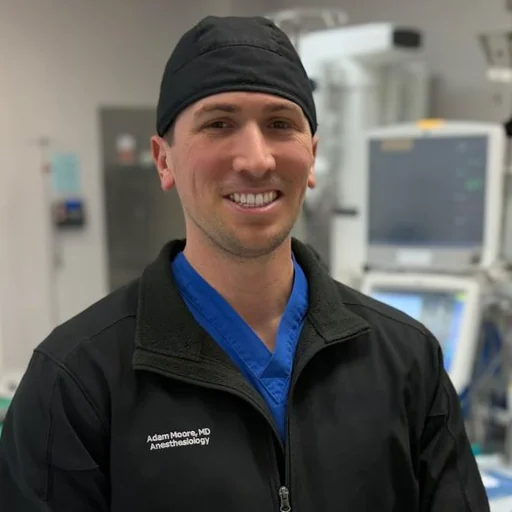
Practicing anesthesiologist with experience across MD-only, medical supervision of CRNAs, and medical direction of CAAs. Founded AnesthesiaJobs.com to help anesthesia professionals find the best job for their personal and professional life.
More about Adam →