Entry-Level CRNA Salary: What New Grads Actually Earn in 2026
Quick Facts
- New grad CRNA starting salary: ~$220,000–$260,000 — new grads earn at or near the national average from year one
- National CRNA median (all experience levels): $223,210 (BLS, May 2024) | Advertised avg: $260,000 (ZipRecruiter, 2026)
- Typical sign-on bonus: $10,000–$30,000+ (up to $50,000 in high-demand areas)
- Student loan burden: $100,000–$200,000 for CRNA programs
- Starting salary with cardiac/call premium: Up to $270,000–$290,000+
- Job growth: 38% projected (2022–2032) — exceptional demand for new grads
- Time to reach median salary: Most new grads start at or above the BLS median from year one
Congratulations — you've completed one of the most rigorous graduate programs in healthcare, and you're about to enter one of the highest-paid professions in the country. But what does an entry-level CRNA salary actually look like? And how do you maximize your first-year earnings while managing student debt?
If you're a soon-to-be or recent CRNA graduate, this guide answers every question about new grad CRNA salary expectations in 2026. The great news: today's new grads earn at or near the national average from day one — there is no significant "new grad discount" in this market. We'll cover starting pay by region, setting, and specialty, plus provide actionable strategies for salary negotiation, geographic positioning, and student loan management. Your first offer matters — but it's rarely the best you can do.
What New Grad CRNAs Actually Earn
📊 Salary Data Sources & Freshness This guide cites data from multiple sources: the U.S. Bureau of Labor Statistics (BLS, May 2024 — latest government data), ZipRecruiter (2026 advertised salaries), Glassdoor, AMN Healthcare, SalaryDr, and other industry reports. Government salary surveys have a 12–18 month reporting lag. Current advertised salaries on job boards typically reflect real-time market conditions and may be higher. Anesthesia provider compensation has risen steadily over the past five years.
The data is clear: newly graduated CRNAs earn significantly more than most healthcare professionals right out of the gate. Here's the realistic picture:
| Experience Level | Expected Annual Salary | Monthly Gross |
|---|---|---|
| New grad (year 1) | $220,000–$260,000 | $18,300–$21,700 |
| Year 2 | $230,000–$265,000 | $19,200–$22,100 |
| Year 3 | $240,000–$275,000 | $20,000–$22,900 |
| Years 4–5 | $255,000–$290,000 | $21,300–$24,200 |
| National median (all levels) | $223,210 | $18,600 |
(Sources: BLS May 2024, ZipRecruiter 2026, job posting data, industry surveys)
The entry-level CRNA salary of $220,000–$260,000 places you in the top 5% of all U.S. earners from day one. New grads now routinely start at or near the national median salary of $223,210 (BLS, May 2024), and current advertised positions average $260,000 (ZipRecruiter, 2026) — your earning trajectory continues upward from there.
How New Grad CRNA Salary Compares
For perspective on just how well new CRNAs are compensated:
| Role | Median/Starting Salary | CRNA New Grad Premium |
|---|---|---|
| New Grad CRNA | $220,000–$260,000 | — |
| Experienced NP | $126,260 (median, BLS 2024) | $94K–$134K more |
| Experienced PA | $130,020 (median, BLS 2024) | $90K–$130K more |
| Registered Nurse | $93,600 (median) | $126K–$166K more |
| U.S. Median Household Income | $80,610 | $139K–$179K more |
(Source: BLS, May 2024, Census Bureau)
Even as a brand-new CRNA, you earn roughly two and a half times the average RN salary and significantly more than experienced NPs and PAs. This is the financial payoff for your investment in CRNA education and training.
New Grad CRNA Salary by Region
Where you take your first job matters enormously. Here's what new graduates can expect across different regions:
Highest-Paying Regions for New Grads
| Region | New Grad Salary Range | Key States |
|---|---|---|
| Northeast | $240,000–$280,000 | Massachusetts, Connecticut, New York, New Jersey |
| Midwest | $225,000–$265,000 | Illinois, Ohio, Michigan, Wisconsin |
| West Coast | $230,000–$270,000 | California, Oregon, Washington |
| South | $220,000–$255,000 | Texas, Florida, North Carolina, Tennessee |
| Mountain/Rural | $225,000–$270,000+ | Montana, Wyoming, Colorado |
(Estimates based on job posting data and industry surveys, 2025–2026)
Key insight: Rural and underserved areas often offer premium starting salaries for new grads. Facilities in these areas may pay $10,000–$20,000 above regional averages because of the difficulty in recruiting providers. Combined with lower cost of living, rural placements can be the smartest financial move for new graduates.
For detailed state-by-state salary information, see our Top 10 Highest-Paying States for CRNAs.
New Grad CRNA Salary by Practice Setting
Your first practice setting significantly affects your starting pay:
| Setting | New Grad Salary Range | Pros for New Grads |
|---|---|---|
| Hospital (large system) | $220,000–$250,000 | Strong mentorship, diverse cases, benefits |
| Hospital (community) | $225,000–$260,000 | Broad experience, often more autonomy |
| Ambulatory Surgery Center | $235,000–$270,000 | Higher pay, predictable schedule |
| Outpatient Care Center | $240,000–$275,000 | Highest pay, focused case mix |
| Rural/Critical Access Hospital | $245,000–$280,000+ | Premium pay, sign-on bonuses, loan repayment |
Nationally, CRNAs working in outpatient care centers earn the most — averaging $263,960 across all experience levels (Source: BLS, May 2024). While new grads won't start at that level, outpatient settings consistently offer higher starting salaries than hospital-based positions.
Should New Grads Start in a Hospital?
Many experts recommend starting in a hospital setting — particularly one with a robust anesthesia department — for your first 1–2 years. The advantages include:
- Broader case exposure — trauma, cardiac, OB, pediatrics
- Mentorship from experienced CRNAs and anesthesiologists
- Structured orientation programs
- Access to complex cases that build clinical confidence
The slight salary trade-off is typically offset by accelerated skill development that positions you for higher-paying opportunities sooner. That said, there's no single "right" first job — the best choice depends on your clinical readiness, comfort level, and career goals.
Boosting Your First-Year Income
Even as a new grad, several factors can push your first-year compensation well above the base salary:
Call Pay
Most CRNA positions include on-call requirements, and call pay can add significant income:
- Weeknight call: $50–$150/hr standby + case pay when called in
- Weekend call: $75–$200/hr standby + premium case pay
- Holiday call: Premium rates, often 1.5x–2x
- Annual call income: $15,000–$40,000+
Overtime
CRNAs who pick up extra shifts or extend beyond scheduled hours often earn 1.5x their base hourly rate. Even occasional overtime can add $10,000–$20,000/year.
Specialty Premiums
New grads who pursue positions requiring specialized skills may start higher:
- Cardiac anesthesia: +$15,000–$30,000 above general start
- OB anesthesia (L&D heavy): +$5,000–$15,000
- Regional anesthesia expertise: Increasingly valued in outpatient settings
Total First-Year Compensation Example
| Component | Amount |
|---|---|
| Base salary | $240,000 |
| Sign-on bonus | $20,000 |
| Call pay | $25,000 |
| Overtime (occasional) | $8,000 |
| Total year-one compensation | ~$293,000 |
With strategic positioning, a new grad CRNA's total first-year compensation can significantly exceed the national median salary — even in your very first year of practice.
Salary Negotiation Tips for New Grad CRNAs
Your first CRNA salary sets the foundation for your entire career earnings trajectory. Never accept the first offer without negotiating. Here's how:
1. Know Your Market Value
Research salary data for your target region, setting, and state using resources like:
- BLS data and our comprehensive CRNA salary guide
- State-by-state salary rankings
- Job postings on AnesthesiaJobs.com (many list salary ranges)
- Peer networking — talk to recent graduates in your area
2. Negotiate More Than Base Salary
If the employer can't move on base salary, there are many other levers:
- Sign-on bonus: Push for $15,000–$30,000+ (common for new grads)
- Student loan repayment: Some employers offer $10,000–$50,000 in loan assistance
- Relocation package: $5,000–$15,000 for moving costs
- CME allowance: $3,000–$5,000/year for continuing education
- Scheduling flexibility: A compressed workweek (three 12s or four 10s) has enormous lifestyle value
- PTO: Additional vacation days are worth thousands annually
- Early salary review: Request a 6-month or 12-month salary review instead of waiting 18–24 months
3. Leverage Multiple Offers
The strongest negotiating position is having more than one offer. Apply broadly, interview strategically, and let each employer know (professionally) that you're evaluating multiple opportunities.
4. Don't Undervalue Benefits
A benefits package can be worth $30,000–$50,000+ annually. When comparing offers, calculate total compensation:
- Health insurance (employer contribution: $8,000–$15,000/yr)
- Retirement match (3–6% of salary: $5,000–$11,000/yr)
- Malpractice coverage ($5,000–$15,000/yr value)
- Disability insurance ($2,000–$4,000/yr value)
- PTO ($15,000–$30,000/yr value)
5. Get It in Writing
Every element of your negotiated offer should be documented in your employment contract. Verbal promises are not enforceable. Review the contract carefully — ideally with a healthcare attorney — before signing.
Student Loan Strategy for New CRNAs
Most new grad CRNAs carry $100,000–$200,000 in student loan debt from their CRNA program, sometimes in addition to undergraduate nursing debt. Here's how to manage it strategically:
Option 1: Aggressive Repayment
- Strategy: Allocate 20–30% of gross income to loans
- Monthly payment: $3,000–$4,500
- Payoff timeline: 3–5 years
- Total interest saved: Potentially $30,000–$80,000+
- Best for: CRNAs with high income, low cost of living, and a desire to be debt-free quickly
Option 2: Employer Loan Repayment
- Strategy: Choose employers offering student loan repayment programs
- Available programs: Many hospitals and rural facilities offer $10,000–$50,000 in loan repayment over 2–3 years
- Stacking: Combine employer repayment with personal payments for accelerated payoff
- Best for: CRNAs willing to commit to a specific employer/location for 2–3 years
Option 3: Public Service Loan Forgiveness (PSLF)
- Strategy: Work for a qualifying nonprofit/government employer for 10 years with income-driven repayment
- Result: Remaining balance forgiven (tax-free)
- Best for: CRNAs with very high loan balances who plan to work in nonprofit healthcare
- Caution: Requires strict adherence to qualifying payment plans and employer types
Option 4: Income-Driven Repayment
- Strategy: Pay based on income (10–20% of discretionary income)
- Monthly payment: Lower than standard, freeing cash for other goals
- Forgiveness: Remaining balance forgiven after 20–25 years (may be taxable)
- Best for: CRNAs prioritizing cash flow flexibility and investing
Recommended Approach
For most new grad CRNAs earning $220,000–$260,000+:
- Build a 3-month emergency fund first
- Maximize employer retirement match — it's free money
- Pursue employer loan repayment if available
- Target aggressive repayment of remaining balance (3–5 year timeline)
- At $175,000+ income, most CRNAs can comfortably repay $150,000 in loans within 4–5 years while maintaining a strong quality of life
Geographic Strategy for New Grads
Location selection is your highest-leverage salary decision as a new grad. Consider this framework:
The "High Pay + Low Cost" Strategy
Target states that offer above-average CRNA salaries and below-average cost of living:
- Massachusetts: $292,390 avg salary (BLS, May 2024), strong healthcare market
- Montana: $256,460 avg salary, 7% below avg COL
- Illinois (outside Chicago): $281,240 avg salary, reasonable COL
- Wyoming: $246,590 avg salary, 8% below avg COL, no state income tax
The "No Income Tax" Strategy
Practice in states with no state income tax to effectively boost take-home pay by 5–8%:
- Texas, Florida, Tennessee, Nevada, Washington, Wyoming, Alaska, South Dakota, New Hampshire
The "Rural Premium" Strategy
Rural and critical access facilities in any state often offer:
- $10,000–$20,000 higher starting salary than urban areas
- Sign-on bonuses of $20,000–$50,000
- Student loan repayment programs
- Housing assistance
- Lower cost of living
The "High-Demand Metro" Strategy
Some metro areas have outsized CRNA demand and pay to match:
- San Diego: $294,180 avg — see California CRNA jobs
- Carbondale, IL: $286,920 avg — see Illinois CRNA jobs
- Boston: $294,460 avg — see Massachusetts CRNA jobs
What to Expect in Your First Year
Beyond salary, here's what the first year of CRNA practice typically looks like:
Months 1–3: Orientation
- Facility-specific training and credentialing
- Supervised practice with experienced CRNAs or anesthesiologists
- Building comfort with the facility's protocols, equipment, and workflow
- Establishing relationships with the surgical team
Months 4–6: Growing Independence
- Increasing case complexity
- Taking call (typically begins within first 3–6 months)
- Developing efficiency and workflow mastery
- Identifying areas for continued growth
Months 7–12: Hitting Your Stride
- Comfortable with the facility's full case range
- Recognized as a contributing team member
- Eligible for performance bonuses or salary adjustments
- Beginning to consider long-term career trajectory
Planning Ahead
By the end of your first year, start thinking about:
- Salary review: Many employers offer 12-month reviews — prepare your case with data
- Specialty development: Identify subspecialties that interest you (and pay premiums)
- Long-term path: Permanent growth? Locum tenens exploration? Leadership?
- Financial optimization: Refinance student loans, maximize retirement contributions, build savings
Related Reading
- How Much Do CRNAs Make? Complete 2026 Salary Guide
- Top 10 Highest-Paying States for CRNAs in 2026
- Locum Tenens CRNA Salary vs Permanent: What Pays More?
- How to Become a CRNA
Ready to launch your CRNA career?
Browse CRNA Jobs on AnesthesiaJobs.com →
New positions are posted daily across all 50 states. Whether you're targeting a top-paying state or a specific practice setting, find your perfect first job. Sign up for job alerts and start receiving personalized job matches today.
Frequently Asked Questions
How much do new grad CRNAs make?
New graduate CRNAs typically earn $220,000–$260,000 in base salary during their first year — at or near the national average from day one. With call pay, overtime, and sign-on bonuses, total first-year compensation can reach $270,000–$293,000+. The national BLS median is $223,210 (BLS, May 2024), and current job postings average $260,000 across all experience levels (ZipRecruiter, 2026).
What is the starting salary for a CRNA right out of school?
CRNA starting salaries range from approximately $220,000 in lower-paying regions to $275,000+ in high-demand areas or outpatient settings. New grads in 2026 earn at or near the national average of $260,000 (ZipRecruiter, 2026), with significant variation by state, setting, and specialty.
Do new grad CRNAs get sign-on bonuses?
Yes, sign-on bonuses are very common for new graduate CRNAs. Typical bonuses range from $10,000–$30,000, with some rural or high-demand facilities offering $40,000–$50,000+. These bonuses usually come with a commitment to stay for 1–3 years, with a pro-rated repayment clause if you leave early.
How long does it take a CRNA to pay off student loans?
Most CRNAs accumulate $100,000–$200,000 in student loan debt for their graduate program. At a starting salary of $220,000–$260,000, aggressive repayers can eliminate this debt within 2–3 years. CRNAs who leverage employer loan repayment programs may accelerate this timeline further.
Should new grad CRNAs start in a hospital or outpatient setting?
Both options are valuable. Hospitals offer broader case exposure and stronger mentorship structures, which many experts recommend for the first 1–2 years. Outpatient settings offer higher starting pay and more predictable schedules. The best choice depends on your clinical confidence, career goals, and available mentorship in each setting.
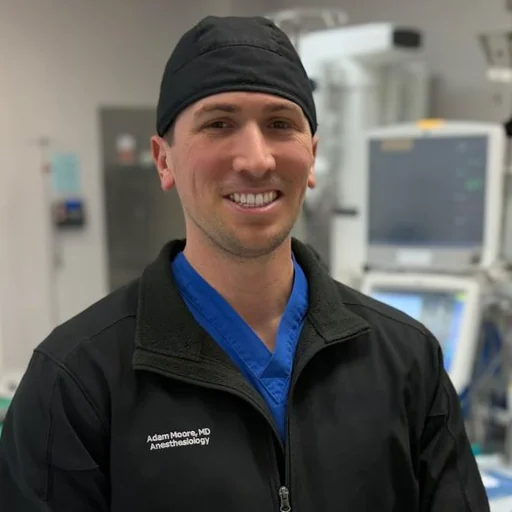
Practicing anesthesiologist with experience across MD-only, medical supervision of CRNAs, and medical direction of CAAs. Founded AnesthesiaJobs.com to help anesthesia professionals find the best job for their personal and professional life.
More about Adam →